
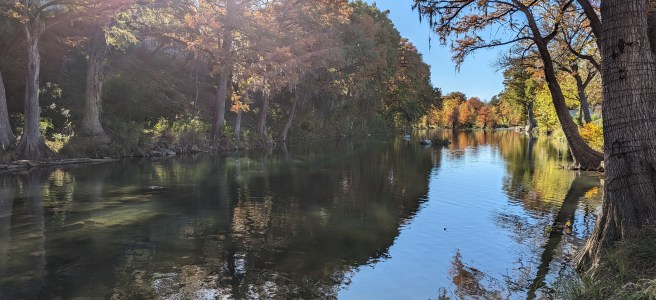
I work at an RV Resort in the Hill Country of Central Texas, and on the morning of July 4th, unlike most days, I brought my raincoat to work. Our resort is located 100 miles from the stretch of the Guadalupe River that runs through Kerr County, and Canyon Lake with its dam lies between the upper reaches of the river and our town. Even still, the thunder boomed, the rain poured, and the flash flood alerts continually lit up every cell phone in the region. Our guests began calling and coming into the store to ask if they needed to evacuate. We told them we were on safe ground. As the news began trickling in of the flash flood in Kerr County the calls and the questions became more urgent; some of our guests packed up and left, “just to be safe.” No shame in that, none at all. The next morning was just as dark and wet, and the news from Kerr County was darker still. An unprecedented amount of rain had fallen overnight, causing a flash flood that roared down the Guadalupe, swallowing RV parks, homes, and campground cabins where children slept. With each hour the numbers of those confirmed dead or missing grew.
Death is a conversation we would rather avoid. But, until the Lord returns, death is a reality we must all face. My husband and I are preparing our estate plans, so our family is ready for our final arrangements when the time comes. When I reminded him to print out the information regarding the cemetery he jokingly retorted, “What—do you think I’m going to die?”
Well, yes. I not only think he’s going to die, I know that we both will. What we don’t know is how or when.
Early this month, a dear saint in our church passed peacefully into the arms of her Savior. Surrounded by her family, Susanna gently and quietly fell asleep in this life and awoke in the next. She is now free from the grip of Alzheimer’s, which cruelly stole her mind and her speech over the last several years. Though her memory failed, her smile never did. Even after the light of recognition left her eyes, she still smiled sweetly whenever I greeted her at church. Even trusting that I’ll see her again, I miss her.
Two days after Susanna died, over a hundred people were violently killed in the raging floodwaters of the Guadalupe River, The magnitude of the event is beyond comprehension. Entire families swept away. Homes, RVs, campground cabins. Vacationers, looking forward to enjoying a long weekend away. Children at summer camp. The stories of heroism and heartbreak filled the news and social media. The numbers of the confirmed dead, the identified and unidentified bodies rose with each update; the number of those still missing in the first weeks is devastating.
The tragedy is that so many lives ended so quickly, so violently, and so many of them were so very young. The tragedy is compounded because there were so many who weren’t found for days and weeks. Searchers dug through massive piles of tangled debris and divers searched below the water. The tragedy has spread to these heroes who have seen too much, and now share the heartbreak of their neighbors who have lost more than they can bear.
I’m not writing today because I can make sense of this. In fact, I’m writing precisely because I cannot make sense of it. Maybe in another 5000 years or so it won’t matter how and when any of those precious little girls from Camp Mystic met their end, but right now it matters. The crushing weight of it matters to every family member who lost a child, a husband, a wife, a mother, a father, a sibling, or an entire family in the rush of the flood waters of the Guadalupe River. I have no answers for why so many lost their lives this way.
But I know who does.
When heartbreak fills the horizon, we must tear our eyes away from what we cannot comprehend and look steadily into the truths we can trust. We must turn to the Scriptures to anchor ourselves when the waves of grief threaten to drown us. Open your Bible to Jeremiah’s lament and see God’s promise in the midst of the prophet’s own overwhelming grief:
The steadfast love of the Lord never ceases;
his mercies never come to an end;
they are new every morning;
great is your faithfulness.
—Lamentations 3:22–23
Look at Romans 8 and see the steadfast love of God spelled out:
Who shall separate us from the love of Christ? Shall tribulation, or distress, or persecution, or famine, or nakedness, or danger, or sword [or flash floods]? . . . For I am sure that neither death nor life, nor angels nor rulers, nor things present nor things to come, nor powers, nor height nor depth, nor anything else in all creation, will be able to separate us from the love of God in Christ Jesus our Lord. —Romans 8:35,38–39
Join those on the mount with Jesus as he promises:
Blessed are those who mourn,
for they will be comforted. —Mattew 5:4
Turn to John 11 and see Jesus weeping with the women at Lazarus’s tomb, even though he knew his friend was going to walk out of there when the Lord called his name. And now to John 17 and listen as Jesus prays to his Father for all his precious loved ones:
“Father, I desire that they also, whom you have given me, may be with me where I am, to see my glory that you have given me because you loved me before the foundation of the world.” —John 17:24
About this prayer, Mark Jones writes:
“We must always remember that when [Jesus] calls one of his loved ones home to himself, he has gained more than we have lost in the death of our loved one. He desires to be with us because he knows us, and that demands that one day he will call us home to be with him. Ultimately this happens not because of something such as a disease or fatal accident, but rather because the Father has answered the prayer of his Son.”[1]
In the aftermath of the Guadalupe flood, there are testimonials filling the news of the faith of those who perished. Many who died were Christians, and their families are finding comfort in the knowledge that their loved ones are now with the Lord. They have been called home. The Father is answering the prayer of his Son.
But when the question of “Why, Lord? Why so suddenly—so violently?” just won’t go away, when I want it to make sense, I’m reminded of an episode in Luke 13. The disciples were trying to make sense of the murder of a group of Galileans, evidently while they were worshipping in the temple. Jesus’s response addressed not only the murder of the Galileans—with the easy target of an evil man, Pilate, to blame—but he added the seemingly senseless deaths of eighteen others who were killed in an accident—a falling tower with no one to blame. And his answer? He bypassed their question and went straight to the point we must grasp. Instead of an answer, he gave them an urgent summons. “Unless you repent, you will all likewise perish” (Luke 13:1–5).
Ultimately—even urgently—this is the most important question. Are we ready to die? Have we repented and believed in the Son of God who alone can save us? We must be ready to meet God. We know that we’re going to die, somehow, someday. Even Lazarus died—again. Death may come suddenly with violence; it may come slowly and peacefully. The most important end of life preparation is this: Am I ready to meet my Lord?
Are you?
[1] Mark Jones, Knowing Christ, Banner of Truth Trust (Carlisle PA: 2015), p. 4.


“I have no answers . . . But I know who does” – such comfort in knowing God is sovereign over every detail. You’ve included some of my favorite go-to passages in times of trouble, and the Mark Jones quote provides a new perspective – the Father is answering the Son’s prayer when he calls our loved ones home. Thank you for writing this, Barbaranne!
LikeLike