
In the first chapter of Ecclesiastes, the Preacher applied his heart to the philosophical question of the meaning of life. In chapter two, he reports the results of his “hedonistic experiments” in finding purpose, meaning, and satisfaction in life through the pursuit of pleasure.
I said in my heart, “Come now, I will test you with pleasure; enjoy yourself.” But behold, this also was vanity. —Ecclesiastes 2:1
The Preacher’s pleasure studies ranged from laughter, wine, and laying hold on folly, to architectural and landscaping projects: houses, gardens and parks filled with all kinds of fruit trees. He acquired great possessions, from male and female slaves to flocks and herds of animals, silver and gold, and the treasures of kings. He assembled singers to fill his days with the delights of his ears and concubines to fill his nights with the delights of his flesh. “He creates a little world within a world: multiform, harmonious, exquisite: a secular garden of Eden, full of civilized and agreeably uncivilized delights, with no forbidden fruits.”[1]
The book of 1 Kings verifies the building projects and vast acquisitions of Solomon in chapters nine and ten. Chapter eleven opens with the women he collected in his pleasure pursuit and the effect they had on his walk with the Lord.
Now King Solomon loved many foreign women, along with the daughter of Pharaoh: Moabite, Ammonite, Edomite, Sidonian, and Hittite women, from the nations concerning which the Lord had said to the people of Israel, “You shall not enter into marriage with them, neither shall they with you, for surely they will turn away your heart after their gods.” Solomon clung to these in love. He had 700 wives, who were princesses, and 300 concubines.—1 Kings 11:1–3
Phillip Ryken comments: “few people have experienced [sex] on quite the scale as king Solomon. . . The exotic luxury of this vast harem was the royal icing on his cake of pleasure.”[2]
He held back nothing to appease his appetites, all the while holding back (or at least claiming to) some part of himself to evaluate his findings. And yet, when he considered all that his hands had done and the toil he had expended in doing it, “behold, all was vanity and a striving after wind, and there was nothing to be gained under the sun” (2:11).
A careful reading of Ecclesiastes 2:1–11 reveals that all these great things that the Preacher did were exclusively for himself and not others (note the repetition of “me,” “myself,” and “I”). He was attempting to enjoy himself for the sake of enjoying himself. The houses were for him; the gardens and parks were private ventures which were not open to the public. hoarding all the wealth and luxuries his position as king afforded him left him empty. “Pleasure, pursued for its own sake, does not and cannot satisfy the soul.” [3]
Pleasure not only left him unsatisfied, but his self-indulgence also led him down the road of sin as he blatantly transgressed the laws of God, particularly concerning the forbidden women he clung to and their foreign gods. “And his wives turned away his heart. For when Solomon was old his wives turned away his heart after other gods, and his heart was not wholly true to the Lord his God, as was the heart of David his father” (1 Kings 11:3b–4). “This compromise of the covenant is what led to his spiritual downfall and divided his Kingdom, which perhaps is why it is listed last among his pleasure experiments—for emphasis.”[4]
Finding that all the worldly pleasures he could possibly grasp brought him no true satisfaction, the Preacher returns again to his first philosophical consideration.
So I turned to consider wisdom and madness and folly. For what can the man do who comes after the king? Only what has already been done. Then I saw that there is more gain in wisdom than in folly, as there is more gain in light than in darkness. The wise person has his eyes in his head, but the fool walks in darkness. —Ecclesiastes 2:12–14
Whoever succeeds his throne will only (at best) live and rule in the same manner as the previous king, but perhaps he can pass on some worldly wisdom to his successor. For he concedes here that after all of his searching for meaning in success and pleasure, he has at least sorted out that wisdom is better than folly. And why is it better? Because there is more gain in light than in darkness. “The value of wisdom is not simply that it gives light, but that it enables us to see. It gives vision, not just illumination. To say that the wise person has ‘eyes in his head’ means that he can actually see what he is doing and where he is going. He has a useful perception of life. By contrast, the fool does not have eyes at all but walks in darkness. this darkness is not just around him but inside him because he has no eyes with which to see.”[5] But just as we read a glimmer of positivity, the gloom closes in again with the Preacher’s next realization.
Then I said in my heart, “What happens to the fool will happen to me also. Why then have I been so very wise?” And I said in my heart that this also is vanity. For of the wise as of the fool there is no enduring remembrance, seeing that in the days to come all will have been long forgotten. How the wise dies just like the fool! So I hated life, because what is done under the sun was grievous to me, for all is vanity and a striving after wind. —Ecclesiastes 2:15–17
In his searching for ultimate satisfaction “under the sun,” the Preacher has come smack up against his own—and indeed, all mankind’s—mortality. “Throughout his lifelong experiment in ultimate meaning, the preacher has not been living like a fool. . . All along he knew what he was doing. Yet now he realizes that even living wisely in this way will not stop him from being placed in a box in the ground, just like the village idiot.”[6] Even knowing the truth that wisdom is better than folly cannot overcome the inevitability of death. His discouragement weighs heavily on him. “I hated all my toil in which I toil under the sun, seeing that I must leave it to the man who will come after me, and who knows whether he will be wise or a fool? Yet he will be master of all for which I toiled and used my wisdom under the sun. . . So I turned about and gave my heart up to despair . . . What has a man from all the toil and striving of heart with which he toils beneath the sun? For all his days are full of sorrow” (2: 18–23). All it amounted to was vanity, vexation, and great evil.
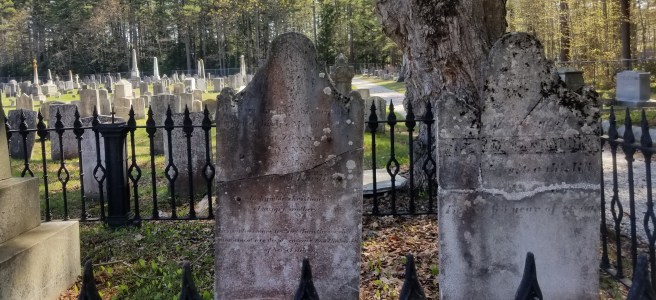
“This section of Ecclesiastes ‘is a sobering account of the relentless anxiety of the materialist who lives under the shadow of unavoidable death.’”[7] In this modern era, we can easily avoid thinking about death. Our ancestors faced it more realistically. In generations past, the churchyard was situated next to or even within the graveyard. To get to the doors of the church for worship, one had to walk past the tombstones bearing the names of their departed family and neighbors. Names which fade as the decades pass, becoming increasingly indecipherable. One generation dies, leaving behind the results of their labors and loves, and whether or not these are appreciated by the heirs makes no difference. Death comes for us all. “Sooner or later everyone comes to the same shocking realization: ‘One day I am going to die; my heart will beat one last time; My lungs will exhale one final breath and that will be the end of my days on this earth.”[8]
The meaninglessness of life and work under the curse of death is palpable in this passage and in the world around us. There can be no ultimate happiness in this domain of darkness. But the Preacher’s next thoughts take a turn for the brighter.
There is nothing better for a person than that he should eat and drink and find enjoyment in his toil. This also, I saw, is from the hand of God, for apart from him who can eat or who can have enjoyment? For to the one who pleases him God has given wisdom and knowledge and joy, but to the sinner he has given the business of gathering and collecting, only to give to one who pleases God. This also is vanity and a striving after wind. —Ecclesiastes 2:23–26
This is not the nihilistic cry of, “eat, drink, and be merry, for tomorrow we die.” Rather, we find here a realistic look at the common grace blessings granted by the Lord to all his creatures. “God has given the good things of this world to us, and they are their own reward.”[9] Enjoying these gifts for what they are, in the moment and not investing them with more meaning than they’re meant to bear, is the purpose for which they’re given. “What if the pleasure of food is a daily joy that we ungratefully overlook? What if our work was never intended to make us successful but simply to make us faithful and generous? What if it is death that shows us that this is how we are meant to live?”[10] Nothing in the world has the capacity to give us the ultimate satisfaction that we seek. But there is someone who can give it.
Whether we choose to face the facts or not, for every man, woman, and child there will come a moment when their hearts beat for the last time, and their lungs cease to draw breath. But there was one man who, three days after his death and burial, his heart beat and his blood began to flow, waking up what was dead a moment before. He breathed in, his living lungs expanded, and the heavy air surrounding death turned to breath again.[11] Jesus rose and walked out of his tomb. This is the man who throughout his life and by his sacrificial death, pleased God (Matt. 3:17). And it is he who grants light and life to those who are found in him (John 1:4; 3:16). Through faith in Christ, the darkness of futility and despair under the curse is banished by the power of his resurrection, and the life he gives will carry us beyond the grip of the grave. Everything that the Preacher achieved is truly rubbish compared to the surpassing worth of knowing Christ Jesus as Lord and Savior (Phil. 3:8–10). So raise your eyes above the horizon of the curse “under the sun” and search out the delight and light of the Son.
If then you have been raised with Christ, seek the things that are above, where Christ is, seated at the right hand of God. Set your minds on things that are above, not on things that are on earth. For you have died, and your life is hidden with Christ in God. When Christ who is your life appears, then you also will appear with him in glory. —Colossians 3:1–4
[1] Derek Kidner, quoted by Phillip Ryken, Ecclesiastes: Why Everything Matters, (Wheaton, IL: Crossway,2010), 49
[2] Ryken, 49
[3] Ryken, 51
[4] Douglas Sean O’Donnell, Ecclesiastes: Reformed Expository Commentary, (Phillipsburg, NJ: P&R, 2014), 48
[5] Ryken, 61
[6] David Gibson, Living Life Backward; How Ecclesiastes Teaches us to Live in Light of the End, (Wheaton, IL: Crossway, 2017), 42
[7] Iain Provan, quoted by Gibson, 42
[8] Ryken, 62
[9] Gibson, 47
[10] Gibson, 47
[11] Andrew Peterson, His Heart Beats, from the album Resurrection Letters, Vol. 1, 2018


